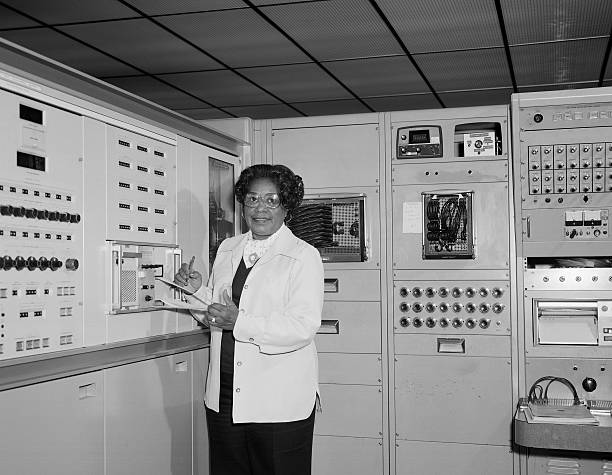
Comments Off on Mary W. Jackson | NASA’s First Black Female Engineer
Mary W. Jackson NASA’s First Black Female Engineer
Mary W. Jackson stands as one of the most inspiring figures in the history of science, engineering, and social progress. Known widely through the book and film Hidden Figures, her real life story goes far beyond a single role or moment. She was not only NASA’s first Black female engineer, but also a fearless advocate for equality, education, and opportunity inside one of the most segregated systems in American history.
Her journey reflects brilliance, resilience, and courage in the face of institutional barriers. At a time when race and gender limited nearly every professional opportunity, Mary W. Jackson refused to accept limits placed upon her potential.
Early Life and Education of Mary W. Jackson
Mary Winston Jackson was born on April 9, 1921, in Hampton, Virginia. From an early age, she demonstrated exceptional intelligence and a deep interest in mathematics and science. She graduated from high school with top honors and went on to attend Hampton Institute, now Hampton University.
In 1942, she earned dual degrees in Mathematics and Physical Science. This academic foundation prepared her for a future that would challenge not only scientific boundaries but also deeply entrenched social norms.
At a time when higher education itself was inaccessible to many Black Americans, Mary Jackson’s academic success was an extraordinary achievement.
Entering NASA During Segregation
Mary Jackson began her career at the National Advisory Committee for Aeronautics, known as NACA, which later became NASA. She initially worked as a mathematician in the segregated West Area Computing unit, where Black women were assigned to perform complex calculations critical to aeronautical research.
These women were called “human computers,” yet they were denied equal recognition, facilities, and professional advancement.
Despite these obstacles, Mary Jackson’s skills quickly set her apart.
Becoming NASA’s First Black Female Engineer
Mary Jackson’s engineering career did not happen by chance. When she was offered the opportunity to work with engineer Kazimierz Czarnecki in the Supersonic Pressure Tunnel, her potential became undeniable.
However, there was one major obstacle. To qualify as an engineer, Mary needed to take graduate-level engineering courses. These classes were held at an all-white high school. Instead of accepting this barrier, she took legal action and successfully petitioned the city of Hampton for permission to attend.
This decision changed history.
After completing the required coursework, Mary W. Jackson officially became NASA’s first Black female engineer in 1958.
Engineering Contributions at NASA
As an aerospace engineer, Mary Jackson authored and co-authored numerous research reports. Her work focused on airflow behavior, boundary layer effects, and aerodynamic forces on aircraft.
Her research directly supported the development of safer and faster aircraft designs. While her name may not always appear in popular history books, her technical contributions were vital to America’s success during the Space Race.
Mary Jackson proved that brilliance thrives even under unfair conditions.
Mary W. Jackson in Hidden Figures
The book Hidden Figures by Margot Lee Shetterly and the subsequent film adaptation brought Mary Jackson’s story to a global audience.
In the movie, Mary Jackson is portrayed by actress Janelle Monáe. Her character highlights the struggles of pursuing engineering credentials in a segregated society, showcasing her determination, intelligence, and bold personality.
While the film simplifies certain events for storytelling, it accurately captures Mary Jackson’s fearless challenge to systemic discrimination and her relentless pursuit of excellence.
Hidden Figures helped restore Mary Jackson’s rightful place in history.
From Engineer to Advocate for Equality
Later in her career, Mary Jackson made a bold and selfless decision. She left her engineering role to become NASA’s Federal Women’s Program Manager and Affirmative Action Program Manager.
In these roles, she worked tirelessly to improve opportunities for women and minorities. She believed that success meant little if it was not shared. Her advocacy helped open doors for future generations of scientists, engineers, and leaders.
Mary Jackson understood that representation alone was not enough. Structural change was necessary.
Awards and Recognition
Mary W. Jackson received multiple honors during and after her lifetime. Among the most notable recognitions was NASA’s decision in 2020 to rename its headquarters in Washington, D.C., as the Mary W. Jackson NASA Headquarters.
This historic move acknowledged her lasting impact not only as an engineer but as a champion for equity.
Her legacy continues to inspire students, professionals, and dreamers around the world.
Mary W. Jackson’s Legacy Today
Mary W. Jackson passed away in 2005, but her influence remains stronger than ever. She represents the countless unsung heroes whose work shaped scientific progress while battling injustice.
Today, her story is taught in classrooms, celebrated in documentaries, and honored by institutions that once excluded people like her.
She reminds us that progress is built not only by innovation, but by courage.
Why Mary W. Jackson’s Story Still Matters
Mary Jackson’s journey is not just a historical narrative. It is a lesson in perseverance, self-belief, and responsibility. She teaches us that talent deserves opportunity and that systems must evolve to reflect fairness.
Her life proves that changing the world does not always require fame. Sometimes it requires refusing to accept unfair rules.
Final Thoughts
Mary W. Jackson’s life is proof that true greatness lies not only in professional achievement, but in lifting others along the way. She was a scientist, a trailblazer, and a reformer whose courage reshaped one of the most powerful institutions in the world.
Her story continues to remind us that the future belongs to those brave enough to challenge the present.