Comments Off on Top Quantum Computing Stocks for Smart Investors
Quantum computing is no longer just a theoretical concept confined to research labs. With breakthroughs in quantum hardware, software, and cloud computing, it is rapidly evolving into a multi-billion-dollar industry. Investors worldwide are showing growing interest as this technology promises to transform industries ranging from healthcare and finance to logistics and cybersecurity. According to McKinsey & Company, the global quantum computing market is projected to reach $97 billion by 2035, driven by increasing investment, technological breakthroughs, and broader adoption across sectors.
Understanding Quantum Computing
Unlike classical computers, which use binary bits to process information as 0s or 1s, quantum computers use qubits. Qubits can exist in multiple states simultaneously, enabling quantum computers to perform complex calculations exponentially faster than traditional systems. This capacity is critical for solving problems that would take supercomputers thousands of years to complete, such as molecular modeling for drug discovery, complex financial risk analysis, optimization of supply chains, climate simulations, and encryption systems.
Why Investors Are Eyeing Quantum Computing Stocks
Interest in quantum stocks has accelerated as major tech companies achieve significant milestones. Google’s “Willow” chip, which can solve ultra-complex problems in minutes, IBM’s Quantum Network providing cloud access to high-performance quantum systems, and Microsoft’s Azure Quantum platform integrating multiple hardware partners, have brought the technology closer to commercialization. As quantum technology evolves, early investors stand to benefit from potential exponential growth. According to a report by Grand View Research, the quantum computing market is expected to expand at a compound annual growth rate (CAGR) of 30.2% from 2025 to 2035.
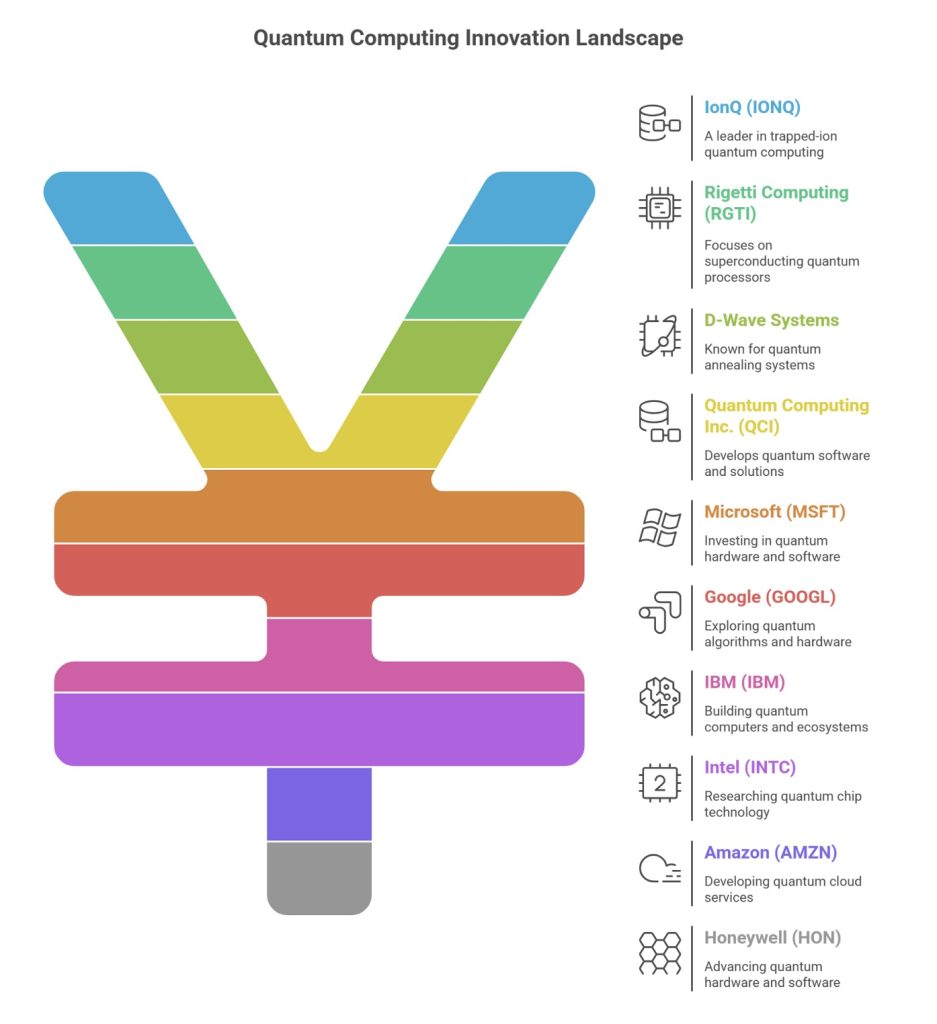
Top 10 Quantum Computing Stocks to Watch
Here are ten leading companies driving innovation in quantum computing, along with relevant financials and performance insights:
IonQ (IONQ)
IonQ specializes in trapped-ion quantum hardware and cloud services. Its stock has surged over 250% in the past year. In 2024, IonQ generated $34.1 million in revenue, with 60% coming from cloud-based quantum services, and reported a net loss reduction of 15% compared to the previous year.
Rigetti Computing (RGTI)
Focused on hybrid quantum-classical cloud computing. Rigetti reported $45 million revenue in 2024, with a $22 million R&D budget to advance quantum hardware. Its quantum cloud platform has doubled the number of enterprise clients over the past 12 months.
D-Wave Quantum (QBTS)
Pioneering quantum annealing technology for optimization and AI applications. Revenue increased 35% YoY in 2024 to $27 million. The company has partnered with several Fortune 500 enterprises to implement quantum optimization solutions.
IBM (IBM)
IBM’s quantum division generated over $220 million in revenue in 2024. IBM offers 127-qubit machines via the Quantum Network, providing businesses and researchers cloud-based access to cutting-edge quantum processors.
Microsoft (MSFT)
Through Azure Quantum, Microsoft integrates quantum hardware from multiple partners. Azure Quantum users increased by 40% YoY, contributing indirectly to $300 million in revenue from quantum-related cloud services.
Alphabet (GOOG)
Google’s quantum research focuses on achieving quantum supremacy. While direct revenue from quantum computing remains minimal, Alphabet invested $150 million in 2024 toward quantum R&D, reflecting long-term growth potential.
Intel (INTC)
Developing superconducting qubits and scalable chip solutions. Intel’s $200 million investment in quantum R&D in 2024 aims to achieve higher qubit fidelity and faster processing speeds.
Honeywell Quantum Solutions (HQS)
Specializing in high-fidelity qubits, Honeywell reported $50 million revenue from enterprise quantum services in 2024. Its cloud-based access subscriptions have grown 25% YoY.
Amazon (AMZN)
Through AWS Braket, Amazon provides access to multiple quantum hardware platforms. Quantum computing services contributed approximately $120 million to AWS revenue in 2024, with adoption among research institutions growing steadily.
Alibaba (BABA)
Alibaba’s DAMO Academy focuses on quantum computing applications in AI and optimization. While revenue is indirect, investment in quantum R&D exceeded $80 million in 2024, with several proof-of-concept projects demonstrating commercial viability.
Risks and Rewards of Quantum Investments
Quantum computing stocks carry risks due to the early stage of technology and market volatility. Many companies are not yet profitable, and delays in achieving “quantum advantage”, when quantum computers outperform classical systems, can impact stock prices. However, the potential rewards are significant, especially for long-term investors who recognize quantum computing’s transformative potential across industries.
Future Outlook
The quantum computing market is expected to continue its rapid growth trajectory. According to the U.S. Department of Energy’s GeoVision report, global investment in quantum technologies could rise 26-fold by 2035. Applications in healthcare, finance, logistics, and cybersecurity will expand, positioning quantum computing as one of the most transformative technologies of the 21st century.
How to Invest in Quantum Computing
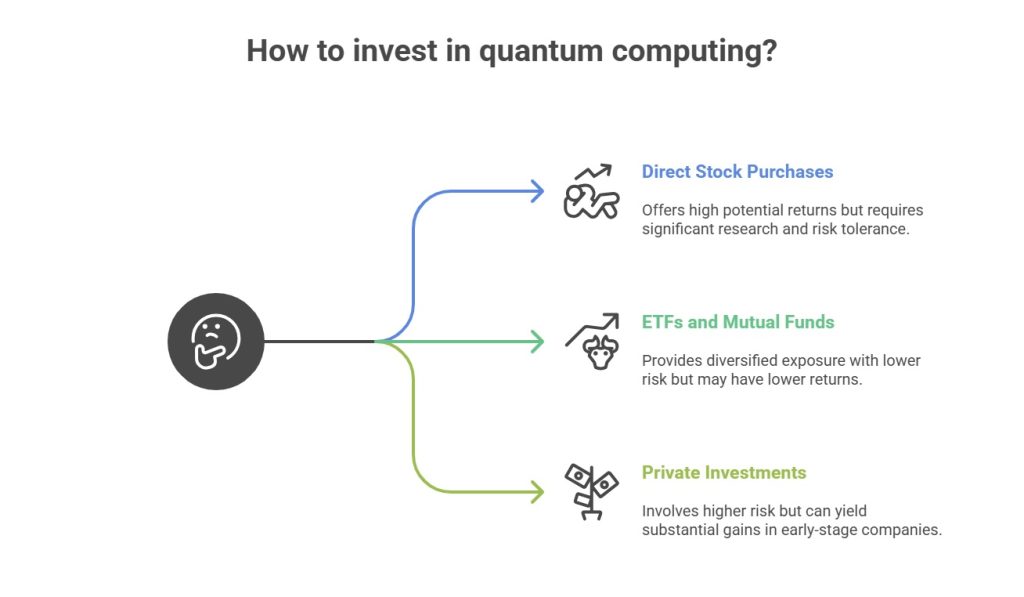
Investors can participate in the quantum computing sector by:
Direct Stock Purchases: Buying shares of leading quantum companies like IonQ, Rigetti, or IBM.
ETFs and Mutual Funds: Some ETFs focused on AI, semiconductors, and emerging technologies include quantum computing companies.
Private Investments: Venture capital and private equity funds offer opportunities to invest in early-stage quantum startups.
Investors should carefully evaluate a company’s technological roadmap, partnerships, and growth strategy. As quantum computing is still in its commercialization phase, stocks can be highly volatile, but early-stage investment could yield substantial returns as the market matures.
Conclusion
Quantum computing is no longer a niche research field, it is becoming a mainstream investment opportunity. With ten leading companies making measurable progress and market projections showing exponential growth, now is an ideal time for forward-looking investors to explore top quantum computing stocks. The coming decade promises not only innovation but also the potential for substantial financial returns in a sector poised to redefine the future of technology.
Frequently Asked Questions (FAQs)
1. What are quantum computing stocks?
Quantum computing stocks are shares of companies that develop or commercialize quantum technologies, including hardware, software, and quantum cloud services. These companies are focused on creating computers capable of performing calculations far beyond the capacity of classical systems.
2. Why should investors consider quantum computing companies?
Quantum computing has the potential to transform industries like healthcare, finance, logistics, and cybersecurity. Early investments in leading quantum companies could provide long-term growth opportunities as the technology becomes commercially viable.
3. Which are the top quantum computing stocks to watch?
Some of the leading quantum computing stocks include IonQ (IONQ), Rigetti Computing (RGTI), D-Wave Quantum (QBTS), IBM (IBM), Microsoft (MSFT), Google (GOOG), Intel (INTC), Honeywell Quantum Solutions (HQS), Amazon (AMZN), and Alibaba (BABA). These companies are at the forefront of quantum innovation.
4. How can I invest in quantum computing?
Investors can invest directly by buying shares of quantum companies, or indirectly through ETFs and mutual funds that include exposure to emerging technologies such as AI, semiconductors, and quantum computing. Private investments in startups are also an option for accredited investors.
5. Are quantum computing stocks risky?
Yes, these stocks can be volatile because the industry is still in its early commercialization phase. Many companies are not yet profitable, and progress can be unpredictable. However, investors with a long-term horizon may benefit from substantial growth as the market matures.
6. What industries will benefit most from quantum computing?
Industries such as healthcare, finance, logistics, cybersecurity, and artificial intelligence will see significant benefits. For example, quantum computing can accelerate drug discovery, optimize financial modeling, enhance encryption, and improve supply chain efficiency.
7. How much is the quantum computing market expected to grow?
The global quantum computing market is projected to reach $97 billion by 2035, with a compound annual growth rate of around 30%. This growth is driven by technological breakthroughs, increased enterprise adoption, and rising investment from governments and corporations.
8. Can I access quantum computers without buying stocks?
Yes, several companies, including IBM, IonQ, and Microsoft, offer cloud-based access to quantum computers. Researchers, businesses, and students can experiment with quantum algorithms and simulations through these platforms.
9. What is “quantum advantage” and why is it important for investors?
Quantum advantage occurs when a quantum computer can solve problems faster than a classical computer. Achieving this milestone is crucial for commercialization, and it can significantly influence stock valuations of quantum computing companies.
10. Is it better to invest in established tech giants or quantum startups?
Both options have potential. Established companies like IBM, Google, and Microsoft offer stability and diversified growth, while startups like IonQ and Rigetti offer higher risk but potentially higher rewards if they achieve breakthroughs in hardware or software.