

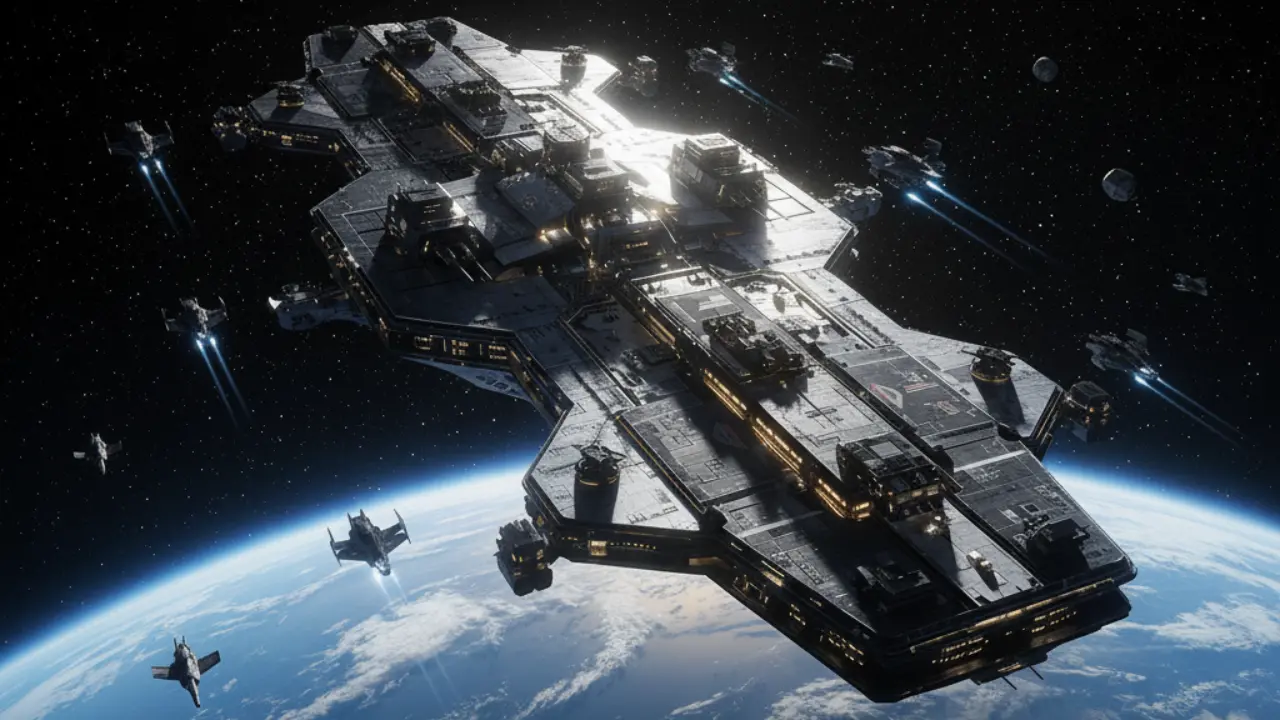
The U.S. Space Force Orbital Warship Carrier, The Future of Military Power in Space

The U.S. Space Force orbital warship carrier, a project that once sounded like science fiction, is now on the brink of becoming reality. Designed as a strategic leap forward in space defense technology, this space force orbital carrier aims to redefine how the U.S. operates in orbit, deploys satellites, and secures control over the increasingly militarized domain of space.
With the U.S. military racing against rising powers like China and Russia in the new “space race,” the Space Force orbital aircraft carrier represents more than innovation; it’s about dominance, deterrence, and defense in the final frontier.
What Is the Space Force’s Orbital Warship Carrier?
The Space Force orbital warship carrier, sometimes called the space force orbital aircraft carrier, is a large, modular spacecraft designed to act as a mobile base in orbit. Imagine an aircraft carrier, but in space, capable of launching, repairing, and refueling satellites or space vehicles without returning to Earth.
The concept of the orbital aircraft carrier has been circulating for a long time, like fiction, but after the establishment of the 6th armed force of the United States Department of Defense on December 20, 2019, serious efforts have begun to make the concept a reality.
The project is being developed in collaboration with Gravitics, a private aerospace company known for its advanced space modules. Supported by SpaceWERX’s STRATFI (Strategic Funding Increase) program, this carrier has already received up to $60 million in funding to accelerate development.
According to Gravitics’ CEO, Colin Doughan, the orbital carrier will serve as a “pre-positioned launch pad in space,” offering unprecedented flexibility for U.S. military and intelligence operations.
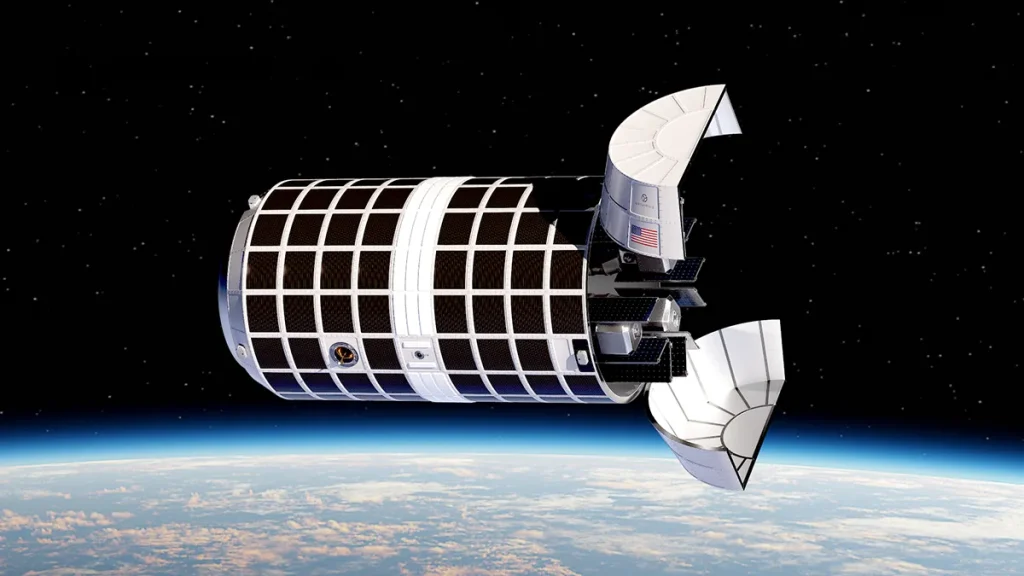
The Vision Behind the Orbital Aircraft Carrier
The U.S. Space Force envisions the orbital aircraft carrier as a tactically responsive in-space platform, allowing the military to:
- Rapidly deploy micro-satellites and drones for surveillance or defense
- Refuel and repair assets in orbit without new launches
- Enhance communication and intelligence networks in real time
- Serve as a deterrent against potential adversaries in space
This “aircraft carrier in space” concept is not simply symbolic, it is a cornerstone of orbital carrier space defense, ensuring that the United States maintains technological and strategic superiority in low Earth orbit (LEO) and beyond.
The Strategic Importance of the Orbital Carrier
The U.S. Space Force orbital carrier is part of a broader shift in defense strategy, from Earth-based missile defense to space-based deterrence systems. This shift acknowledges a growing truth: whoever controls space, controls the planet.
Some analysts compare this to the evolution of naval warfare in the early 20th century, when aircraft carriers transformed global power dynamics. In much the same way, the orbital warship carrier could become the backbone of future military dominance.
Its potential roles include:
- Early detection and neutralization of enemy satellites or missiles
- Autonomous defense coordination between AI-driven systems in orbit
- Secure communications between U.S. and allied forces
- Real-time reconnaissance and global surveillance coverage
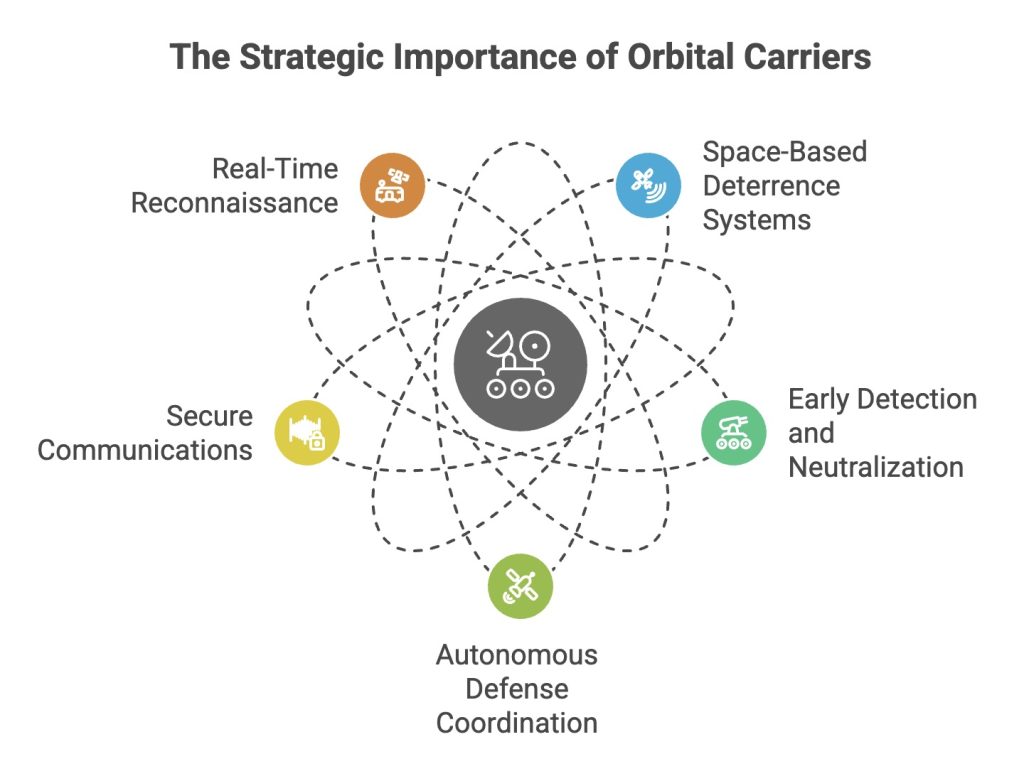
This initiative signals the U.S. military’s long-term commitment to orbital readiness, preparing for a world where conflicts extend far beyond Earth’s atmosphere.
What Mass Thinks: Buzz or Breakthrough?
On Reddit’s defense and space forums, discussions around the space force orbital carrier reveal both excitement and skepticism. Users describe it as a “large in-orbit refueling tank or repair station” rather than a literal “warship.” Some believe it could evolve into a manned spy satellite platform, while others think the term “orbital carrier” is largely a PR buzzword.
One Redditor pointed out the cost dilemma: launching such a massive military asset into orbit could cost billions, yet it could still be destroyed by a relatively inexpensive missile. Others countered that if it’s manned or strategically essential, the political and military consequences of attacking it would make such an action nearly unthinkable.
Another interesting perspective found was
“If it were manned, the odds of it getting intentionally shot down drop significantly.”
And that’s precisely why the Space Force orbital aircraft carrier might play more of a symbolic deterrent role, much like nuclear submarines, visible enough to show presence, yet elusive enough to avoid direct confrontation.
The Gravitics Partnership: Building the Future of Orbital Defense
Gravitics, the private space manufacturer leading the project, has emerged as one of the most innovative defense-space firms in the United States. Its modular space station technology allows for scalable construction, enabling the Space Force orbital carrier to expand, refuel, and adapt to mission requirements.
Their collaboration under SpaceWERX’s STRATFI initiative combines funding from the U.S. Department of Defense (DoD), Small Business Innovation Research (SBIR) programs, and private investors, a public-private model that accelerates military innovation.
This partnership echoes NASA’s success with SpaceX, but this time, for defense. As Gravitics CEO Colin Doughan stated:
“The Orbital Carrier is a game-changer. It acts as a pre-positioned launchpad in space, bypassing traditional launch constraints and enabling space vehicle operators to rapidly deploy on demand.”
Design & Technical Capabilities
While official blueprints remain classified, concept designs of the Space Force orbital carrier reveal a modular, satellite-like structure that unfolds in orbit. This configuration could enable the carrier to store, maintain, and launch multiple small crafts or satellites.
Key potential features include:
- Unpressurized bays to protect sensitive electronics
- Docking ports for multiple spacecraft
- Solar arrays and nuclear micro-reactors for energy
- Automated robotic arms for maintenance and assembly
- AI-based defense systems for monitoring orbital threats
According to reports, the orbital carrier may operate at low to medium Earth orbit, offering rapid response capabilities for both defensive and offensive operations.
This marks a strategic evolution in military space power, from static satellites to dynamic, responsive orbital systems.
Legal and Ethical Debates: The Outer Space Treaty Dilemma
One of the most discussed concerns, both online and among international policymakers, is the Outer Space Treaty (OST). Signed in 1967, this treaty prohibits the placement of weapons of mass destruction (WMDs) in orbit.
While the Space Force orbital warship carrier itself may not violate this rule, its dual-use potential (civilian and military) raises questions about weaponization in space.
As a few people noted:
“That’s illegal, as space WMDs are banned by the Outer Space Treaty. Though I wouldn’t put it past the current administration to violate that.”
This highlights a broader ethical question: can space remain a peaceful domain when militaries are building “carriers” capable of rapid satellite deployment and possible orbital strikes?
Why the Orbital Warship Carrier Matters
- Global Security:
Ensures the U.S. maintains orbital dominance against rising space powers. - Technological Edge:
Enables faster deployment and protection of satellite networks. - Strategic Deterrence:
Acts as a visible symbol of U.S. military capability in orbit. - Operational Efficiency:
Reduces launch costs and response times in crises. - Innovation Driver:
Promotes new technologies in propulsion, AI, and modular design.
The Space Force space aircraft carrier isn’t just about warfighting; it’s about future-proofing America’s orbital infrastructure.
Potential Risks and Challenges
Despite its promise, the space force carrier faces significant hurdles:
- High development and launch costs
- Vulnerability to anti-satellite (ASAT) weapons
- Orbital debris risks (space junk could damage or destroy the carrier)
- Geopolitical escalation with China and Russia
- Public skepticism over space militarization
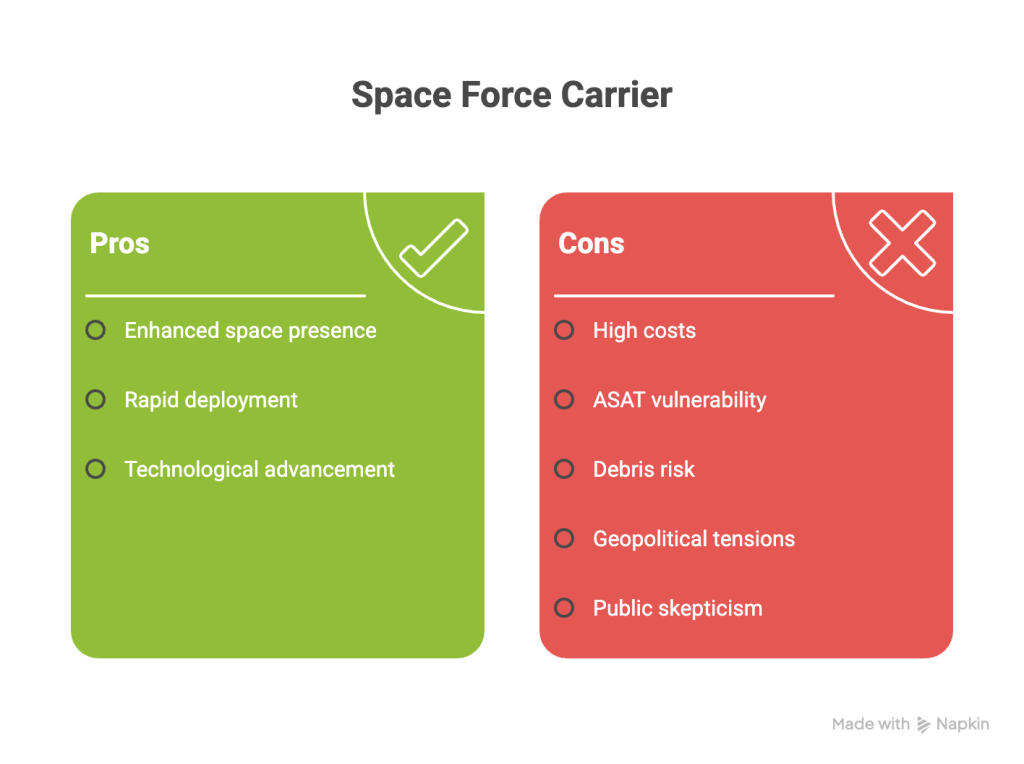
These challenges make the Space Force orbital carrier not just a technological feat but a test of diplomatic and strategic balance in the space era.
The Future, Toward an Orbital Fleet
The orbital warship carrier could mark the beginning of a new military doctrine, a fleet of orbital defense platforms designed for autonomous coordination. Future carriers might carry:
- Drones for satellite repairs and surveillance
- Laser defense systems against enemy satellites
- Autonomous “guardian” crafts to patrol critical orbital lanes
This “orbital navy” would transform space into a fully integrated extension of Earth’s defense networks, connecting air, land, sea, cyber, and orbit into a single theater of command.
As the Space Force nears completion of its first orbital warship carrier, the world watches a new era unfold, one where power is measured not just in land or sea, but in the silent vacuum of space.
Conclusion: The Dawn of Orbital Power
The U.S. Space Force’s orbital warship carrier represents a paradigm shift in global military strategy. Whether it becomes a symbol of deterrence, a tool for peacekeeping, or the beginning of a new arms race depends on how responsibly this technology is used.
As with all revolutions in military capability, innovation comes with both promise and peril. One thing is clear, the next frontier of warfare, defense, and power projection is no longer on Earth. It’s orbiting above us.